Category Archives: Uncategorized

Christmas Traditions Secular and Sacred

Ghost of Christmas Present

Looks like the Ghost of Christmas Present plays handbells, I’d say an F4.


“Tradition is a gift of the Spirit.”  –Brian D. McLaren, A Generous Orthodoxy.

I would venture to say that most families who observe the holiday have Christmas traditions, and those traditions differ widely. I encountered this diversity in a dramatic fashion during one of my creative writing classes. Each student wrote a story about a holiday, and one young woman wrote about a family who spent their Christmas holiday at a hotel. She read her story, which was rather good, and I showed my lack of knowledge and sensitivity when I commented, “I like the story, but no one goes to a hotel at Christmas. Otherwise, your story is quite plausible.”

I’ll never forget her answer. “Mine does.”

Oops. I learned an important lesson that day which has to do with not assuming that anyone’s reality or experience matches anyone else’s. That seems obvious, but I ignored that fact that afternoon in writing class.

So, here are a few of our family’s Christmas traditions, some serious, some religious, some funny and some just plain odd. I hope they recall for you some of your traditions during this season.

To begin at the beginning, so to say, I remember that the Baptist church I went to as a child did not have services on Christmas Eve. When I joined Manassas Baptist Church in 1970, the pastor instituted a Christmas Eve service that year or the year following. We also had an 11 PM Christmas Eve several times in the past 45 years, but stopped when attendance dwindled.

I was convinced for quite a while that Baptist churches did not have services on Christmas Day, but recently I talked to a couple of people whose churches did. Wrong again.

For as long as I can remember, near the end of our Christmas Eve services, Becky has played an arrangement of “Silent Night” by Dudley Buck as the worshipers lit their candles from those carried by deacons from the Christ candle. (Ralph Powell, longtime choir member, lit the choir’s candles from his cigarette lighter.) Our daughters called the Buck arrangement “Spooky Silent Night” since it began with a series of ominous chords which eventually resolved into a soft rendering of the carol, suggesting the coming of light into darkness*.

When “Silent Night” was over and the congregation had lifted their candles, everyone launched into a spirited version of “Joy to the World” as they left the sanctuary. After that, the choir sang the “Hallelujah Chorus,” and a number of people stayed to listen, applauding at the end.

At home, we also have a number of traditions, of course. Instead of putting our name in the “from” area on gift tags, we use the people’s names the recipient can’t stand or has no chance of ever meeting. For example, I can’t abide the Today show and its cast. Naturally, last year I received presents from Al Roker, Hoda Kotb and Kathy Lee Gifford. Imagine my delight when I saw this. Not. I have also received presents from our cats and from famous authors. I didn’t know they cared. We have fun guessing who gave us each present, and we laugh a lot while we’re opening them.

Amy and Alyssa also do a lip synch version of Maria Carey’s “All I Want for Christmas Is You.” Alyssa channels Maria’s signature moves while Amy “sings” backup with the most vacant expression I’ve ever seen. I just about roll on the floor with laughter every time they do it.

Normally, after the brunch we go over to have a fabulous meal and open presents at my mother-in-law Wilhelmina Detwiler’s house. The menu is the same every year, but no one’s complaining. The women in the family are fantastic cooks, and they all have signature dishes they make and the food is great! Sometimes I am allowed to make the tea, which I suppose is my signature drink, although making it is incredibly easy with my Mr. Coffee Tea Pot. (Does anyone else detect a contradiction in that name? How can Mr. Coffee make tea? And yet he does, the versatile fellow.)

When it’s time to open presents, we sit in the same places, the older folk in the living room and the young ones out in the hall and on the stairs. We have a good time taking the paper off and commenting on the marvelous presents we’ve received.

After that, we clear the table, put the paper away and take our presents to our cars. I’m sure everyone takes a long winter’s nap after that, and another busy, bustling Christmas season is over.

I hope your Christmas was good and that this piece has caused you to think about your own traditions. And, as Tiny Tim said, “God bless us, everyone!”

*Here’s a link to the song:  https://www.youtube.com/watch?v=37-hLnE90qY)


Leave a comment

Filed under Uncategorized

A Christmas Apart

Steam Loco in Winter

I’ve shared this story before, but I thought it appropriate for the Christmas season. Mata’s Story is an unpublished novella in which Otto Kerchner’s sister Mata tells some of the stories from the Beyond the Blue Horizon series from her perspective as a ninety year old. This selection is Chapter 36 from that book and takes place in December, 1942

Mata speaks:

What do I remember about Christmases? I remember so much that if we both lived to be a hundred and ten, I would tell you one-tenth of what I remember. Christmas is such a glorious time, full of excitement, secrets, sharing, preparing, time with family, the coziness of being inside with colorful decorations while the world is frozen outside. I’m sure you have such memories as well.

Of course, Christmas can also be difficult at times. I think of that first Christmas without my Pete after he was killed by that car. Forgive me while I recover myself.

Ah, now that’s better. Then there was the year I thought I wasn’t going to speak to anyone the rest of the year after Pete died. I was just too angry, at what or who, I do not know, but thank goodness I recovered in time and didn’t spoil it for everyone, including myself. But one of the most difficult Christmases came during the war, in 1942, when Otto was coming home for the first time since he had gone into the service.

As I have told you, we lived south of town, and the train actually ran past our farm. I had to drive north to Pioneer Lake to the small station on the Milwaukee Roads line. Pioneer Lake was of course much small then, and all the shops had closed for Christmas Eve by the time I went through town. The day was overcast, with light fading fast as the sun sank behind the trees. I had to turn my car lights on the last mile or so.

I remember standing on the platform of the station, huddled against the cold in my cloth winter coat I had worn for ten seasons, turning my back to the frigid Wisconsin wind with my head down. We knew there would be no new clothing for us on the home front, or not much, so our motto was “Make it do, use it up or do without.” And we did.

I raised my head briefly, blinking back tears from my eyes caused by the wind. The train wasn’t in sight. Silly girl, I scolded myself. It wasn’t necessary to see it. I would hear the whistle of the steam locomotive long before it arrived around the bend.

A handful of neighbors waited with me for the arrival of Milwaukee Roads Train Number 57, due in five minutes. Civilians rarely drove far because of rationing, and if they did travel any distance, they went by train if they could get a seat. All our resources and material went into the war effort. Anyone who didn’t live through this time can’t understand it. I rarely heard anyone complain, though. We all were having to make do, and we were all in the same boat. No use complaining and making it more difficult for anyone than it already was.

I quickly calculated how long it had been since I had seen Otto. He left for the Army Air Corps in March of 1942, and his last letter home came in early December. So that’s, what?  Eight months? It seemed longer. Time crept though those months, and I attributed the slowing of time to all the unfamiliar work I had to do, learning how to manage the family’s dairy med, negotiating prices, hiring what few men were available and capable of the hard physical work involved. Of course, I wasn’t alone. Millions of women were doing the jobs of men who were off to war. I couldn’t help but feel that this change would not only last for the duration but years and even generations in the future, and I believe history proved me right.

I peered down the platform to see if I could tell who the couple was at the other end. It had to be someone with a family member in the service. Almost all the trains carried troops or supplies. My eyes cleared for a moment, and I saw it was the elder Petersons. They ran a home construction business, but they couldn’t get materials or labor with the war going on. Oh, sure, the military was building military bases and factories, but our little town was too far away from everything to warrant either. That was all right with me. I loved the tranquil life on my parents’ dairy farm, although it bad been hard to enjoy it lately. I caught myself once again in these thoughts. Think of the poor people on the front lines and those who work under such difficult conditions. Think of Otto far away from home, I.  No, I had little to complain about. And business was brisk, with word that the Army would soon be coming as far north as our town. That would mean a tremendous boost to our business, although I could have done with it since it involved war and so much displacement and suffering. Ah, well, there was a job to be done, and I would do my part.

I wondered how our parents would seem to Otto. It didn’t seem to me that they had changed that much during his absence, but I knew it was harder to see someone change when you were around them all the time. I didn’t think Mama’s dementia had gotten any worse, although some days were better than others. And while his paralysis had slowed him down some, Papa was still in charge of the farm. He couldn’t do what he used to, but he didn’t hesitate to tell anyone else how to do a job. Fortunately, his mind was still sound. Occasionally I thought he was too abrupt with the workers and with me, but I had found over the years that if I talked to him gently, he soon calmed down.

A distant steam whistle sounded from the south, and I moved to the center of the platform so I’d would be able to get to Otto quickly. He had never been away this long before, and I had been mulling over the first words I would say to him. He seemed the same in his letters home, but again you never know. He could have changed in ways that didn’t show up in the letters. The wind blew harder, and I drew my coat collar over my head. That helped, but not much. Mrs.  Peterson came up to me with her husband trailing behind as usual. “Hello, Mata! Do you remember an old lady? I know you’ll be glad to see Otto. I’ve missed seeing all our young men around.” Pete was the eldest of the four brothers, and the only one old enough to serve.

“And I know you’ll be glad to see Pete again.”

Ja, we have missed him as our son, and he was such a good worker, although he would probably have had to go to Minneapolis to find work if he hadn’t gone into the service.”

“We’re all glad to have our boys back for a while.” Could you say anything more obvious? I thought. The brilliant white headlight of the locomotive cut through the onrushing air. It was right on schedule, which was unusual these days. The loco’s boiler loomed nearer and nearer, until seemed to fill my field of vision entirely. Then the huge black machine slid by, brakes squealing, venting steam down the line of coaches. The train strained to a stop, and the engineer blew off the excess steam. The conductor climbed down the steps of the first coach, holding a small wooden box in his right hand. He carefully put it in place and then stood by as the passengers came out. None of them needed help since they were all young men with a smattering of women. I counted ten people, but none of them was Otto. What could have happened to him?

The train crew clambered down from the locomotive, and I watched as the relief crew took its place. I walked over to the first coach where the conductor looked up and down the line. He apparently was about to call “All aboard!” when he noticed I striding toward him. He tipped his cap to me. “What can I do for you today, Miss?”

“Has everyone who’s going here gotten off?”

“Yes, m’am, I had six passengers for Pioneer Lake, and they all got off. I count them as they get on, don’t cha know and I count them again when they get off. On some trains, they’re not awakened or called at our stop, but not on my train.”

My face fell. “Oh.”

“He’ll likely be on the next train. I’m sorry.”

“But today is Christmas Eve, and there’s no train tomorrow. The earliest he could make it is the 26th.”

“I am truly sorry, Miss. But now we have to leave. I have to keep to a schedule. I’m sure you understand.” He tipped his hat to me and called, “All aboarrd!” He swung up the steps, and the train pulled out, slowly at first but then with increasing speed,, and it was gone as if it had never been there, vanishing around the bend. I heard the whistle blowing for a grade-level crossing to the north of the station.

I watched it vanish from sight, put my head down into the wind and fought my slow way back to the car. Once in and glad to be out of the weather, I laid my forehead against the steering wheel and felt my tears come, freezing as they slid down my cheeks. After a few seconds, I straightened up, started the engine and picked my way back home among the black ice patches on the state highway.

The sun set early that time of year, and by the time I pulled up in the driveway of the old farm house, night had spread its inky cloak over all I could see. I thought that phrase came from something we had studied in my senior class, Hamlet, perhaps. I turned my face to the sky, thinking how cold and distant the stars were that night. If I had to go to tend the cows at night, I always saw those distant points of light as warm, even inviting, but not this evening. Christmas was just a few hours away and my brother was not there.

I opened the door and wondering how my parents fared. When I left for the station an hour earlier, I felt filled with hope and expectation, but the bright flame of that hope and that expectation had gone out. I hoped I would be able somehow to keep thet fire alive.

I stopped in the kitchen because I heard someone, no, two someones, singing an old German carol Es ist ein Ros’ entsprungen.

I thought it was the radio at first, but as I went into the living room, I saw that it was my Mama and Papa, singing the old, old words with conviction. I have never heard it sung so beautifully before or since.

Es ist ein Ros’ entsprungen.

Aus einer Wurzel zart.

Wie uns die Alten sungen,

Aus Jesse kam die Art

Und hat ein Blümlein bracht,

Mitten im kalten Winter,

Wohl zu der halben Nacht.


Das Röslein das ich meine,

Davon Jesaias sagt:

Mama ist’s, die Reine,

Die uns das Blümlein bracht:

Aus Gottes ewigem Rat

Hat sie ein Kindlein g’boren

Bleibend ein reine Magd.

I paused in the hall. Mama could go for days without talking, and when she did, I could not make out most of what she was saying. But there she was, singing a clear harmony with Papa. Maybe there are no more miracles, but as I bowed my head in the cold kitchen I knew I had witnessed one, truly a Christmas miracle. I prayed, “Thank you, Lord,” and lifted my head. Tomorrow was another day and more importantly, it was Christmas Day. I felt something a warm glow in my heart, hope and expectation burning brightly there against the piercing wind and bitter cold of war and winter.

Leave a comment

Filed under Uncategorized

A Postcard from D.C.


I’m pleased to feature my friend and fellow choir member Bernard Tate as a guest blogger today. Bernard writes and edits a newsletter for the Army Corps of Engineers in Washington and commutes to his office there. He explained how this writing came about:

I occasionally send a “Postcard From D.C.” to my friends, and I thought you and Becky might enjoy this one.  (I cribbed the idea straight from the “Postcard From Iraq” feature that the U.S. Army Corps of Engineers created for our people on duty in Iraq.)  My “postcards” are random and sporadic…I have to see something that catches my fancy.

Here’s Bernard’s account of taking the train and finding some pleasant surprises. Thank you, Bernard. I hope my readers enjoy what you’ve written.

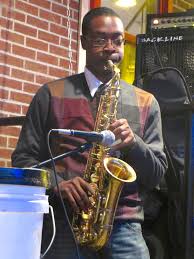
Saxophone player

I left the office early yesterday to catch the train home, and I’m glad I did.

                I ignored several panhandlers on my walk from the office to Union Station, but as I passed the escalator to the subway, I heard someone down there playing Christmas carols on a brass instrument.  Since I had plenty of time, I rode the escalator down, and saw  a homeless man at the Metro entrance playing Christmas carols for the crowds walking past.  I assume he was homeless because his clothes had  the worn, random look of  homeless clothing, and his teeth were a dentist’s nightmare.  But he was playing a bright gleaming saxophone and blowing it good, too — the tip bag in his sax case was near overflowing.  I pulled several dollars from my billfold and told him I didn’t mind giving a few bucks for music that good.

                And then just a few moments later, walking through Union Station, I passed a quartet of young people singing an a cappella version of “Gloria in Excelsis Deo”.  Since I had plenty of time, I stopped to listen for a few minutes.  It was a standard quartet — two men and two women, soprano/alto/tenor/bass.  When they finished and the little crowd listening had applauded, I asked where they were from & what group they were with.

They said they were just people who liked to sing and had gotten together that day in an ad hoc quartet.  I was astonished…they sang as if they had rehearsed for weeks.  No tip jar there…they were just four people singing for pleasure and to entertain the crowds hurrying through Union Station.

                I sometimes miss the Virginia hills and small town life where I grew up, but this city has nice moments, too, if you have time to stop and enjoy the music.

               Bernard

Leave a comment

Filed under Uncategorized

The Children Shall Lead Them

GMCC 4

Rebecca Verner conducts the older Greater Manassas CHildren’s Choir at the Manassas Church of the Brethren, December 6

I should have known something was up when I first pulled into the parking lot at the Manassas Church of the Brethren.

Cars and vans filled the lots around the church, so I had to park in the overflow area behind the building. About 350 proud parents, grandparents, other relatives, friends, classmates, teachers, musicians and church members had come to see the inaugural concert of the Greater Manassas Children’s Choir on a sunny Sunday afternoon.

I found a place to sit in one of a number of chairs set up along the sides of the sanctuary just as the 17 singers of the younger choir (grades 2-4), directed by Stonewall Middle School choral director Susan Dommer, presented the first of two sets of nine songs which included a Handel piece, nonsense tunes, a song about animals, and one about winter in Virginia–and they sang in at least eight different languages.

The older choir (grades 5-8), directed by Manassas Chorale Artistic Director Rebecca Verner, also presented nine varied songs, also in two sets. (Full disclosure: Becky and I have been married for 42 years.)

The packed house responded as only those who love their singers can, applauding wildly, taking pictures and recording videos.

I was impressed by the purity of tone, articulation, blend, enthusiasm and overall musical abilities of these young people. They comported themselves well, and responded to praise from members of the audience politely and maturely.

The Greater Manassas Children’s Choir an affiliate of the Manassas Chorale, which added the choir to its five-year plan in 2008. Work on the group didn’t begin until 2014 when Verner, Dommer and a number of dedicated volunteer musicians put in about 200 hours selecting music and publicizing the group. They began rehearsals in early September, and Sunday’s concert marked their first full-fledged effort.

I had written earlier that I wasn’t going to listen to secular Christmas songs this year, but these bright, earnest smiling faces changed my mind. Thanks, young people. Thanks for sharing your music and for giving me back my Christmas music.

1 Comment

Filed under Uncategorized

The Grinch Who Stole My Music

Ray Coniff Christmas Album Cover

I love music. Anyone who has known me for more than five minutes knows that I’ll start raving about Gordon Lightfoot or talking about the choral groups I’m a part of or breaking into a pop song that fits the situation. If a friend says, “I’m leaving from Dulles tomorrow,” I might bust out with

You’re leavin’ on a jet plane

But I know when you’ll be back again

Oh, man, do you need some kind of ride?

Most people (but not all) appreciate my efforts.

So clearly I love music. I know I wrote that at the beginning, but by repeating that, I hope you’ll realize how much I love music. There—that was a third time. Somebody stop me!

The point to all this chatter about how much I love music (fourth time) is that this year, I am not going to listen to secular Christmas songs. In other years, I would have listened to some of my favorite songs like “Believe,” “Little Saint Nick” and “The Peace Carol,” but not this year.

Why this sudden change? Why religious songs and not the secular ones? Have I suddenly become a zealot who wants to burn all the Ray Conniff Christmas albums or stop people on the street to educate them about the creeping evil of secularism?

Not quite.

I’m just not in the mood. My father spent most of 2014 in doctors’ offices and died of multiple organ failure in January. I received 49 radiation treatments for cancer in 2013 (the treatment was successful, thank God) and dealt with a number of side effects. Mass shootings and acts of terrorism dominated the media.

I know, people suffer and die every year, sometimes in horrible ways. What’s the difference this year?

I don’t know. I have simply reached a tipping point and don’t want to hear about how Rudolph the Red Nosed Reindeer saved the day.

Please don’t call me up to recommend a psychiatrist or offer some medication. I appreciate it, but I’m in as good a mood as I can be. And please don’t quote scripture at me. I’m no theologian, but I am Baptist and have studied the Bible for about 63 years. (We start early and don’t quit.) One horrible year, I recounted all the bad things that happened and ended by saying the next year had to be better, and it was. Some helpful soul wrote an email reminding me of Paul’s admonition to give thanks in all circumstances. In the first place, I was aware of the verse. In the second, Paul did not tell us to be happy when we’re in prison or bitten by a snake but rather to realize that God is still with us and cares for us. I believe this even though I won’t sing about jolly old Saint Nicholas this year.

The title of this piece refers to the Grinch, and I ask you, Who’s the Grinch? Is it I? Is it disease or war or terrorism or starvation or suffering? Or is it the overblown celebration of the birth of a simple peasant baby?

It’s up to you. You decide.

Leave a comment

Filed under Uncategorized

Feeding the Children

Starving Child

Every day around the world 6,000 children die of starvation.

I found that such a startling statement, let me repeat it. Every day around the world, 6,000 children die of starvation.

We see pictures of malnourished, crying, homeless children wasted by disease and hardship and want to do something

So, how do we address a problem that is so pervasive and so difficult to comprehend, much less do something about?

A number of groups are working to eradicate starvation. This past Sunday, I participated in training for one effort sponsored by Feed My Starving Children and NorthStar Church Association that will feed 100 children for a year. That’s 35,000 meals for kids who would otherwise suffer or even die.

How is that done? Agricultural giants Cargill and General Mills worked with Feed My Starving Children, a group dedicated to doing just that, to develop MannaPackRice, a mixture of rice, soy, vitamins, minerals and vegetarian flavoring and dehydrated vegetables that would keep without refrigeration. This combination specifically meets the nutritional needs of starving children and also improves the health, growth and physical well-being of children who are no longer in danger of starvation. The ingredients are sealed inside plastic bags and packed in boxes for transport all over the world. One bag feeds six children and costs about $1.32 to produce.

The training I took part in will allow me and others there to participate in “2016 Food Fight!,” a three-day event at the Dulles Expo Center May 13-15. Thirty thousand  “packers” will prepare 5 million meals to feed 14,000 children for a year.

We sent over 100 people from our church representing a wide range of ages and types to the training. Come May, we’ll be ready to do something about world hunger. Come join us! Until then, visit http://www.2016foodfight.com/ for much more information.


1 Comment

Filed under Uncategorized

The Legend Lives On

20101110_012512_EdmundFitzgerald[1]

Forty years ago this past Tuesday, the ore carrier Edmund Fitzgerald sank without warning in a monster storm on Lake Superior. Moments before they dropped off radar, the captain reported “We’re holding our own,” the freighter sank with the loss of 29 souls, the entire crew.
The sinking might have gone largely unnoticed but for the efforts of Canadian singer-songwriter Gordon Lightfoot, who read an article in Newsweek about the sinking which began,
According to a legend of the Chippewa tribe, the lake they once called Gitche Gumee “never gives up her dead.” Modern-day mariners of Lake Superior know the legend has some basis in fact…
He used this passage in the beginning of the song and narrated the story using the best information he had at the time. One verse read,
When supper time came the old cook came on deck
Saying fellows it’s too rough to feed ya
At 7PM a main hatchway caved in
He said fellas it’s been good to know ya.

Initially, authorities thought that the ship sank because the crew failed to properly secure the huge hatches on the main deck. Families objected, saying the captain and crew were far too conscientious to have left such an important task undone. Later analysis showed that the carrier probably encountered “rogue waves,” two exceptionally large formations in a row that appeared without warning. One wave lifted the Fitz from the bow while another hoisted the stern, leaving the hull between bearing the entire weight of the cargo. The ship broke in two and plummeted to the bottom, taking crew and cargo with it.
Lightfoot changed the lyrics to his song to reflect this new reality.
At 7 p.m., it grew dark, it was then he said, ‘Fellas it’s been good to know ya.’”
The song later went on to receive considerable airplay at the time, unusual for a ballad that ran over eight minutes. I think that Lightfoot portrays the danger of plying the waters and the courage of the mariners. His creation of a work that recognizes both and honors the sacrifice of so many brave men stands as a testament to human perseverance and creativity. In spite of risk, we as humans continue to dare the elements and as we do, we have the poets and writers among us to record those stories. I can’t think of a more potent combination.

Leave a comment

Filed under Uncategorized

A Horse with No Name

A Horse Named Otto

I don’t know if you are familiar with the pop rock group America and one of their biggest hits, “A Horse with No Name.” The chorus goes,

          I’ve been through the desert on a horse with no name:

          It felt good to be out of the rain

          In the desert, you can’t remember your name

          ‘Cause there ain’t no one for to give you no fame.

I have several questions about this: what in the world is anyone doing in a desert on a horse, named or no? And how much rain would you have to endure to relish being in a place where daytime temperatures reach upwards of 120 degree Fahrenheit with little water in sight? Do the extreme temperatures cause you to forget your name and why should you need fame to remember who you are? I don’t know the answers to these questions. I was hoping you would, so talk to me after we’re done and enlighten me as to these mysteries.

Our family always thinks of a young woman named Chrissie, an intelligent young woman who became a lawyer. She took piano with Becky when her family lived here. One day I was taking her to her piano lesson, I think, and I had the car radio tuned to a ‘70’s and 80’s hits station and Chrissie listened for a while and asked, “Mr. V, is this the ‘Horse with No Name’ station?” And it was. This question has become part of our family lore, used when any kind of soft rock is being played anywhere. Chrissie later took guitar lessons and told me that one of the first songs they learned was—you guessed it—“A Horse with No Name.”

On a somewhat more serious note, our names are important to us. They give us an identity and may be a source of pride or aggravation depending on what they are and who we are. Parents agonize over what to name their babies and sometimes they don’t choose too wisely. One study found that a bad first name can not only ruin your self-esteem, but it may actually make you lonelier — and dumber. And no one wants that.

Some actual names that might cause problems for a hapless girl are Audi, Chia, Hennessy, Merci, Monet, Nixon, Zeek, and Zuly. For boys, the names are Anthem, Denim, Dior, Hershey, Piers, Simba, Vino, Walden, and Zeppelin. Led or not, I don’t know.

If you find yourself in the desert, I hope you have a horse, even if it doesn’t have a name, and I also hope your name isn’t one that causes problems, and most of all, I hope that  you can remember your name. Good luck.

Leave a comment

Filed under Uncategorized

Middle Memory

Memory

In the mind’s present kingdom,
All is not clear,
But all is closer than it seems,
And our latest imaginings and
Present happenings
Fade, a forgotten dream,
Recede into the
Near distance, only to
Materialize in
Middle memory
Where they dwell
For a time
Between present and middle.
Remembrance sinks into
The porous soil of the mind,
Only to sprout like new grass
In most distant regions
Where live poetry, song, creatures, friends and story,
And this is where we in our most present state
Most fully live.

Dan Verner
October 31, 2015

1 Comment

Filed under Uncategorized

Daylight Saving Crime

DST

Yep, this is pretty much how I feel the week after a time change.

Well, it’s that time of year when we all run around like proverbial chickens with their heads cut off, moving our clocks back and suffering from jet lag for about a week. Daylight Saving Time is a crime. It imposes an economic burden, increases accidents and just plain irritates quite a few people.
According to a post on the “Huffpost Healthy Living” page, “the semi-annual time change might be costing the American economy as much as $434 million, according to a new index based on past research on heart attack incidence (published in the “New England Journal of Medicine”), workplace injury in mining and construction (published in the “Journal of Applied Psychology”) and cyberloafing (published in the “Journal of Applied Psychology”) all with regard to daylight saving time.
“Researchers noted that the actual financial toll may even be higher, because the index did not include impacts on car accidents or injuries in other fields (like transportation or manufacturing). A past study in the New England Journal of Medicine showed an association between loss of sleep from DST and an increased car accident risk.”
Daylight Saving Time was set up during World War I to give workers and particularly farmers more light in the evening to work by. Electricity was not widespread, particularly in rural areas, so the practice had some value. With the advent of near-universal electric power, DST simply isn’t necessary any more. An argument in its favor is that it gives workers more daylight in which to have picnics, play golf or sit outside, but I wonder if the cost of $1.4 million for every man, woman and child to suffer jet lag, endure an untoward economic burden and increase their chances of dying in an automobile accident is worth it. I don’t think it is, and it’s time to change. Write your member of Congress and keep writing until we have this thing beat. Give us back sun time and a better life.

Leave a comment

Filed under Uncategorized